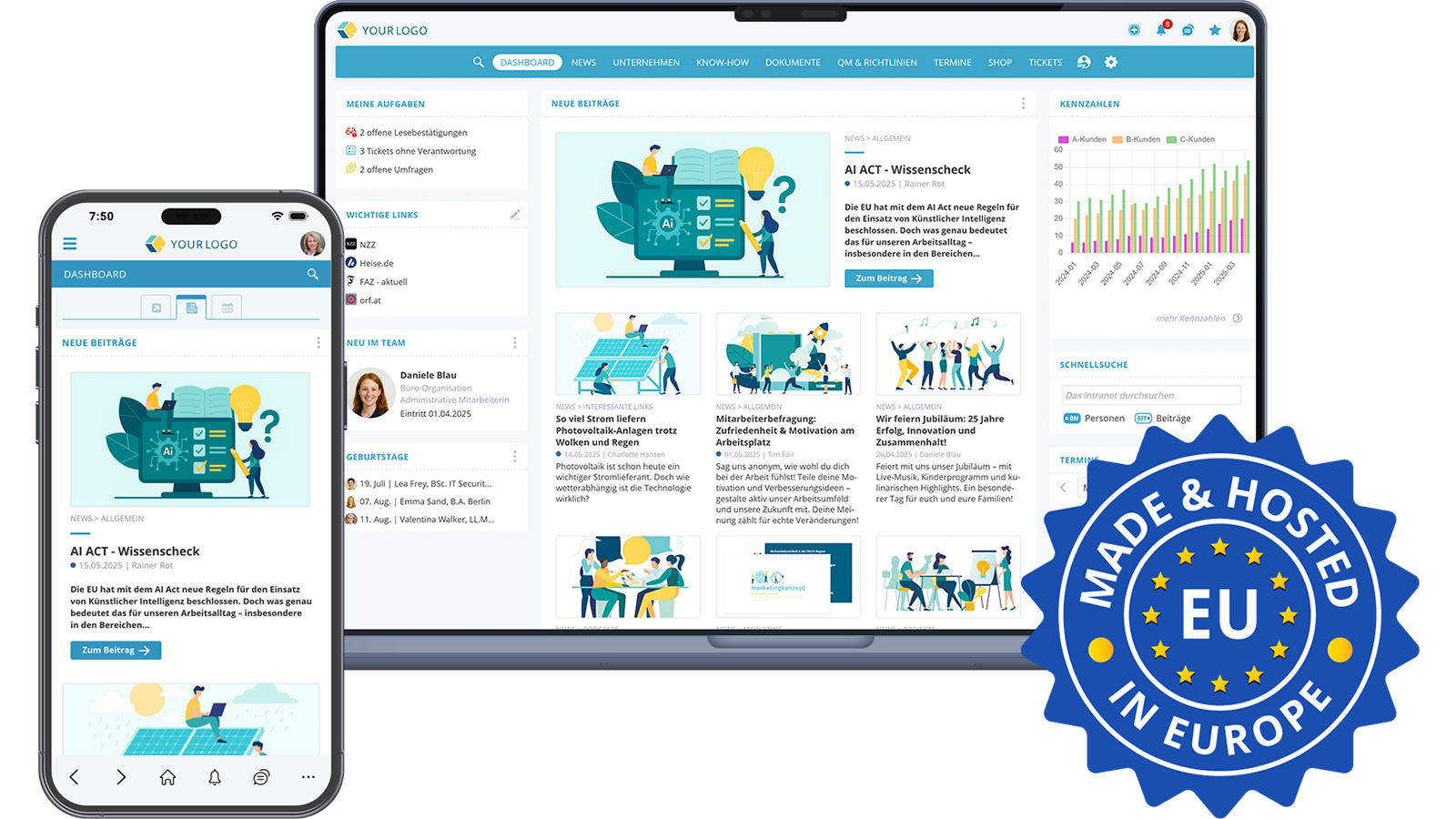

What is a company wiki in the intranet?
In an increasingly digital workplace, handling knowledge efficiently has become a decisive competitive advantage. Organisations face the challenge of not just collecting knowledge, but making it genuinely accessible and usable.
A company wiki in the intranet is a central, digital knowledge platform where employees can collaboratively document, update and share what they know. Unlike static folders on a file server, intranet knowledge management thrives on interaction, shared maintenance and the ability to make information available across departments and locations.
A straightforward, modern approach is to capture knowledge and expertise inside a social intranet. This kind of knowledge management works like an internal company wiki — a dynamic platform that lets employees share knowledge collaboratively and access it from anywhere within the organisation. The knowledge base ensures that not only safety-critical guidelines or technical processes are documented, but also the everyday organisational knowledge that keeps things running. A company wiki or enterprise wiki drives knowledge sharing and strengthens the organisation's capacity for innovation.
In a modern social intranet, knowledge management is one of three core pillars of the platform: alongside sharing information (news, announcements, chat) and providing internal services (forms, tickets, workflows), capturing and finding knowledge is at the heart of everyday collaboration. According to McKinsey, organisations can raise the productivity of knowledge workers by 20 to 25 % when social technologies and knowledge sharing are consistently put to work ("The Social Economy", McKinsey Global Institute, 2012).
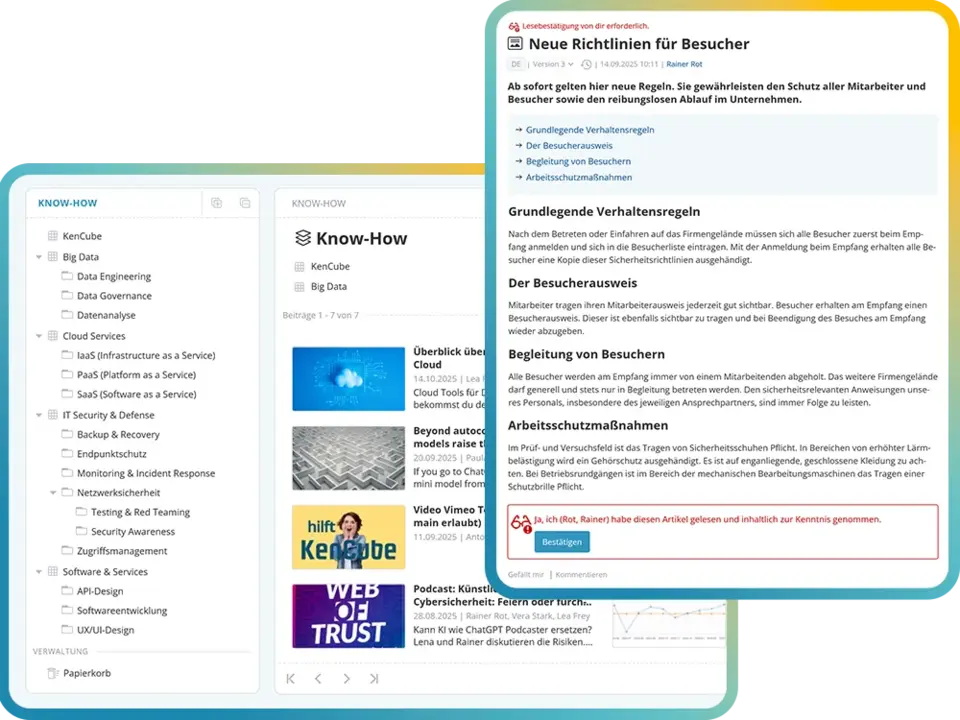 Structured organization of knowledge and expertise within the social intranet
How it all started
Our story begins in the 1990s with a situation many business owners will recognise: a company founder was approaching retirement. He wanted to preserve his decades of experience, knowledge and know-how and make it permanently available to his company. It was a process that mattered not just to him, but to the entire organisation. He had spent a lifetime building the business and knew it inside and out. The thought of what would happen after he retired — and how his colleagues would manage without his expertise — kept him up at night. The solution that eventually emerged: before retiring and handing over the reins to his successors, he would consolidate everything he knew in an internal company wiki in the intranet. It had to be online — accessible everywhere, by everyone. A flexible permission system and a clear structure were equally important. Certain areas needed to be restricted to specific departments. And every employee should be able to contribute their own knowledge, not just read what others had written.
1. Knowledge is alive: the power of interactivity in the company wiki
Knowledge is something living — it grows, and it changes over time. In many organisations, knowledge is defined and communicated by only a handful of people. But for knowledge management to truly work, it needs to be used and shaped by many. Good knowledge management in an intranet is not just top-down communication; it also flows bottom-up.
The great advantage of storing knowledge in a social intranet is interactivity — the ability for everyone in the organisation to add their own experience and expertise to existing entries. Old articles in the internal knowledge hub can be revised or updated. Entries can be written collaboratively with colleagues who contribute their know-how. Good intranet solutions include automatic version control, so earlier versions can always be retrieved. The social intranet is interactive: employees can comment on knowledge articles, add to them and, in many cases, create them from scratch.
"Knowledge is alive. Knowledge management in a social intranet improves continuously through interactions like comments and updates." Andreas Buchwald, CEO and co-founder of KenCube
The knowledge in the company wiki is available to the entire workforce, regardless of location. Knowledge management in a social intranet creates a unique opportunity to communicate at eye level. Sometimes, things work quite differently in practice than they do on paper — and the company wiki gives organisations a channel for honest, practical feedback on how processes really run. Adding and using knowledge is not hierarchical. Only sensitive information needs to be restricted to specific individuals or groups. Over time, both managers and employees come to see that documenting knowledge is not wasted time, but an investment in the future.
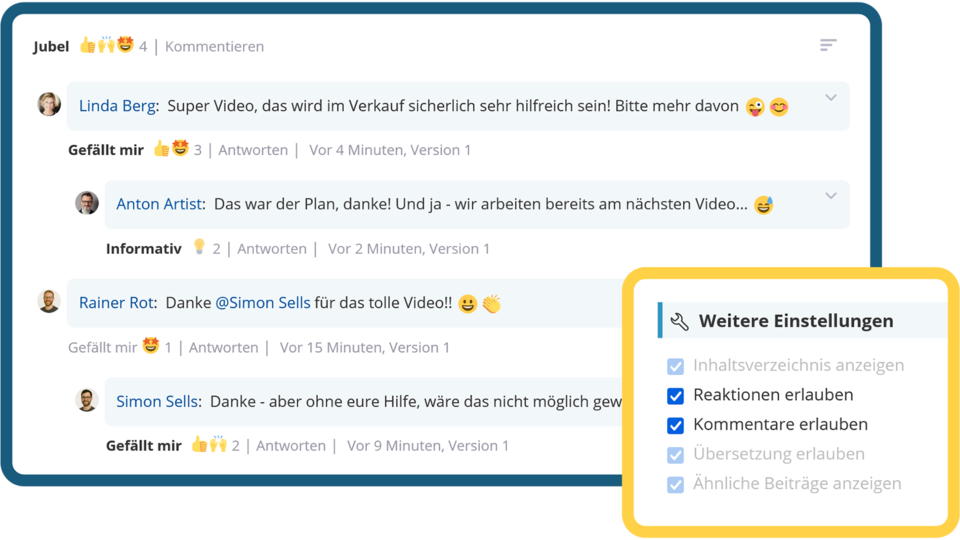 Give feedback and actively participate in discussions
2. What can be stored in a company wiki?
Knowledge management goes far beyond technical documentation. A company wiki in the intranet can hold everything that makes daily work easier and contributes to efficient collaboration, for example:
- All types of instructions or regulations, e.g. for machinery or compliance purposes
- Practical, organisational information and tips and tricks for everyday working life — from the nearest affordable fuel station to parking rules and security policies
- Background information, e.g. on markets and customers
- Studies and research findings relevant to the organisation's products or services
- Documentation, e.g. for certifications
- Onboarding and training materials: once recorded, they can be used again and again
- Events, invitations to meetings and announcements, optionally with attached materials
- Practical know-how that has proved valuable in specific situations, whether dealing with a printer, a production line or a particular customer
- Organisational workflows and process descriptions, e.g. how approvals or procurement processes work
"Good knowledge management is not about how academic it is, but whether it is actually used in practice." Thomas Gottwald, CEO and co-founder of KenCube
A major advantage of modern social intranet solutions is that particularly important knowledge articles can be marked to require a read confirmation. They can also be sent directly from the intranet to the entire workforce by e-mail or push notification, prompting employees to read specific content and absorb new knowledge.
Important knowledge can also be followed by a quiz, allowing organisations to check whether content has been read and understood. If a knowledge article needs to be linked to an action item, a ticket can be attached in just a few clicks — ready for the relevant employees to work through.
3. Knowledge vs. news: getting the structure right in knowledge management
Organisations sometimes wonder where to draw the line between long-term knowledge and current news. A new insight or a process change may initially be shared as a news item, but should also be stored permanently in the knowledge management system. The solution is straightforward: a news article can deliver the headline quickly and concisely, while a linked knowledge article provides the full detail and background. This keeps important content permanently accessible while the news item highlights what is new.
A well-structured company wiki in the intranet also prevents knowledge from disappearing in the daily stream of news after a few weeks. News informs in the moment; knowledge management keeps the content safe for everyone, for the long term.
4. Prerequisites for successful knowledge management in the intranet
Building an internal knowledge base is not always straightforward. There may be voices within the organisation who see documenting knowledge in a company wiki as a waste of time. In such cases, buy-in and visible support from leadership — ideally leading by example — is essential. Getting started does take some effort, but over time it saves enormous amounts of time and resources. Working becomes more effective, more efficient and more sustainable. It is also crucial that the intranet and the tools it provides are easy and intuitive to use. Employees should not need to attend a training course just to add a parking policy or a quality management guideline to the intranet.
Knowledge management only works if people can find the knowledge
Knowledge management achieves nothing if no one can find or read the content. That is precisely why storing knowledge in a social intranet makes so much sense. Modern social intranet solutions come with a powerful search engine that allows fine-grained filtering of results by content type, tag, person and more. Atlassian has found that employees spend up to 10 hours per week searching for information (Atlassian: Knowledge Management for Enterprises). A well-structured company wiki with an integrated search can cut that figure significantly.
5. The role of AI in intranet knowledge management
AI integration is a game-changer for knowledge management in the intranet. At the employee's request, AI can answer questions about knowledge content, summarise long articles, assist with writing new entries and even generate matching images. The AI can be configured to treat all intranet content as its knowledge pool — delivering instant, context-aware answers based on the organisation's own information.
Keeping data quality high is critical here. Outdated or inaccurate information can lead to wrong conclusions. Continuously reviewing and updating the knowledge in the company wiki is therefore essential.
As AI becomes more deeply integrated, new possibilities for intranet knowledge management continue to emerge. AI can help automatically categorise content, suggest relevant articles in search results, or extract knowledge from a range of documents. For SMEs and mid-sized organisations, this means the company wiki stays current and findable even without a dedicated editorial team.
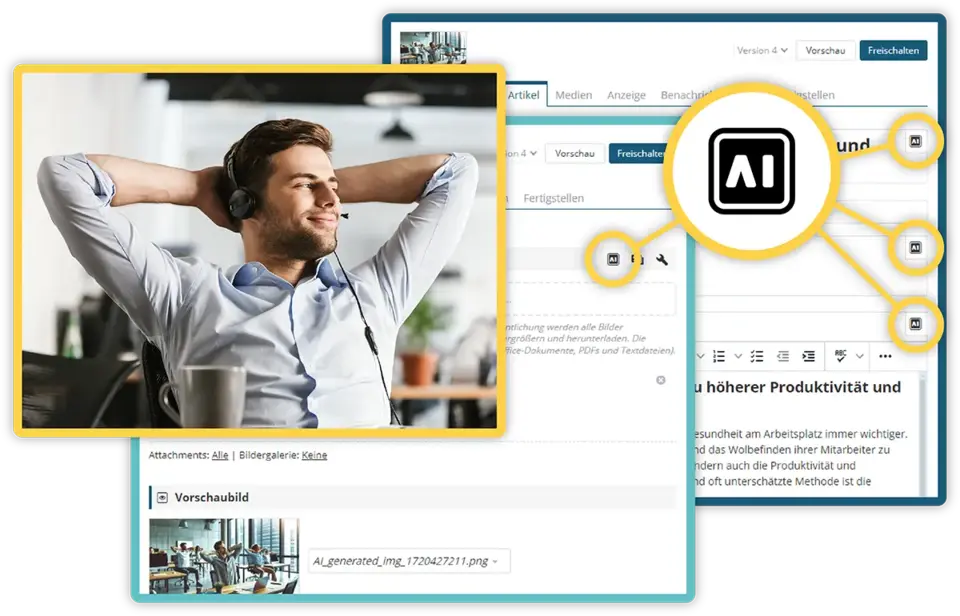 AI tools support the editorial team in content creation
6. Benefits of a modern company wiki in the social intranet
Making knowledge available to all employees in a social intranet is essential for smooth operations and efficient collaboration ("The Social Economy: Unlocking Value and Productivity through Social Technologies", McKinsey Global Institute, 2012). It saves a great deal of time in the long run. Without it, processes, experiences and know-how have to be explained over and over again — costing experienced key employees some of their most valuable time. IDC research shows that knowledge workers spend an average of 2.5 hours a day searching for information. A well-structured company wiki can reduce this significantly.
When background information about customers, tips for operating machinery and similar knowledge are available centrally, it accelerates and improves the work of everyone involved. A company wiki in the intranet can add value across every department and area of the business. Here are some of the key benefits:
Interconnection and structure in the company wiki
Unlike loables cross-references between pieces of information, hyperlinks to related articles and interactive use. Tags can be created for specific topics to help organise stored knowledge. Referencing individual people is also possible.
Better visibility compared with file servers
Storing knowledge in the social intranet means content can be structured and updated far more effectively. Content is generally much more visible than it would be on a file server. Keeping information current is also easier than maintaining folders on a server or managing knowledge through e-mail chains.
Access to knowledge management from anywhere
A digital knowledge platform lets employees access relevant information from any location — whether in the office, on the shop floor, working from home or at a customer site. Because a social intranet can also be used via an employee app, employees do not need a desktop, laptop, work e-mail address or company phone to reach the organisation's internal knowledge base.
Comments and social interaction
The social dimension of an intranet is one of its defining features. Through everyday interaction, knowledge in the social intranet is discussed, expanded, shared, continuously improved, corrected and adapted to real-world practice. Employees can do more than passively consume knowledge — they can actively contribute, leave comments and likes, and suggest updates or additions. Linking knowledge articles to tickets with specific action items also supports the growth of the knowledge base. The result is an archive that improves continuously.
Multimedia content in the company wiki
The easy integration of multimedia content makes knowledge articles in the social intranet more engaging. Articles can be enriched with audio and video content, graphics, images and interactive presentations — making knowledge more attractive and more relevant to daily practice. The knowledge base develops naturally as a result.
Permission management
Not all information is relevant or appropriate for every employee. The flexible permission system of a social intranet solution ensures that specific areas or content are only viewable and editable by authorised individuals or groups.
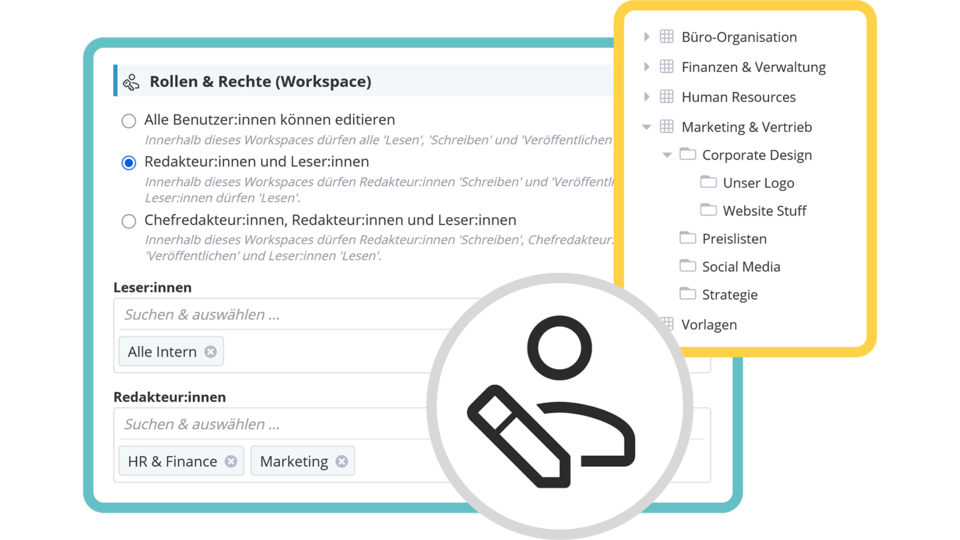 Structured organization of content in workspaces with rights management
Powerful search and filter functions in knowledge management
The single most important factor for fast access to all stored knowledge is a powerful, full-text search. Modern social intranet solutions support search by keyword combinations, content type, tag and more, along with essential filter options.
Tip: A critical factor is building employees' trust in the knowledge platform. Once they trust it, they will use it willingly. Users need to reach a good result quickly — or know clearly when there is no result. That may sound obvious, but it is essential for the platform's success and for the trust placed in it.
Frequently asked questions about company wikis in the intranet
What is a company wiki and how is it different from a file server?
A company wiki in the intranet is an interactive, interconnected knowledge platform where employees can collaboratively create, update and comment on content. A file server stores documents in folder structures with no linking, versioning or social interaction. On a file server, employees search longer for up-to-date versions and outdated documents lead to errors. In a company wiki, current knowledge is always structured, searchable and just a few clicks away.
What content belongs in a company wiki?
A company wiki should hold all the information that gets used regularly in day-to-day work: instructions, process descriptions, onboarding materials, compliance guidelines, product knowledge, customer background and practical tips and tricks. In short: everything that has so far been passed on verbally or lives in personal notebooks.
Who maintains the knowledge management system in the intranet?
Knowledge management in the intranet thrives on shared responsibility. In principle, any employee can create or add to entries. Permissions can be set for sensitive or central content to control who may edit. Leadership plays a crucial role as a role model: when management actively uses the company wiki, it motivates the entire workforce to contribute.
How long does it take to set up a company wiki in the intranet?
With a modern social intranet solution that is intuitive to use, a foundational company wiki can be up and running productively within a matter of weeks. A step-by-step approach works best: start with the most important content, involve the workforce and expand the knowledge management system gradually. Experience shows that the intranet quickly becomes the central go-to point once employees realise they can reliably find the information they need there.
Why is a company wiki especially important for SMEs?
In SMEs and mid-sized organisations, knowledge is often concentrated in a small number of key people. When experienced colleagues leave the company or retire, valuable know-how is at risk of disappearing. A company wiki in the intranet preserves this knowledge permanently and makes it accessible to everyone, regardless of staff changes or locations. For SMEs that do not have a dedicated knowledge management team, an intuitive intranet solution with an integrated company wiki is the fastest path to structured, cross-departmental knowledge sharing.
Conclusion
Continuous improvement as a success factor
Successful knowledge management depends on continuous maintenance and active use by employees. It needs to be easy to access, designed for interactive use and updated regularly. Organisations that embrace this approach benefit from more efficient collaboration, reduced knowledge loss and measurably higher productivity. Knowledge management is not a one-off project — it is an ongoing process and a significant opportunity to optimise the entire organisation sustainably.
"Check the wiki first!"
Whatever happened to the company whose founder set up an internal wiki in the intranet back in the 1990s, ahead of his retirement? The next generation still uses the enterprise wiki as their knowledge base in the social intranet today — and the company continues to thrive. Whenever someone in the business asks where to find a piece of information, the standard answer has long since established itself: "Check the wiki first!"
Want to see how a company wiki in the KenCube Social Intranet would work for your organisation? We'd be happy to walk you through it in a live demo.

Working as a consultant in the IT industry for over 30 years, specialist in software development, AI-supported data processing and neural networks, studied at WU Vienna
 Praktische Feature-Auswahl